
Titanium dioxide (TiO₂) is highly valued in sunscreens for its broad-spectrum UVA and UVB attenuation; however, its application is hindered by two significant challenges: high photocatalytic activity and a tendency to aggregate. The photocatalytic nature of TiO₂ generates reactive oxygen species (ROS) that can cause skin irritation and oxidative stress, while particle aggregation diminishes UV absorption efficiency. Although conventional inorganic coatings like silica are used to mitigate these effects, they often require energy-intensive synthesis and fail to completely suppress photocatalytic activity. To address these gaps, researchers explored bio-derived polysaccharides—specifically α-1,3-glucan and ethylcellulose—as potential solutions. These biopolymers were chosen because they are sustainable, biodegradable, and can be applied through mild processing to create protective shells that simultaneously enhance UV protection, passivate the TiO₂ surface, and improve emulsion stability.
Methods
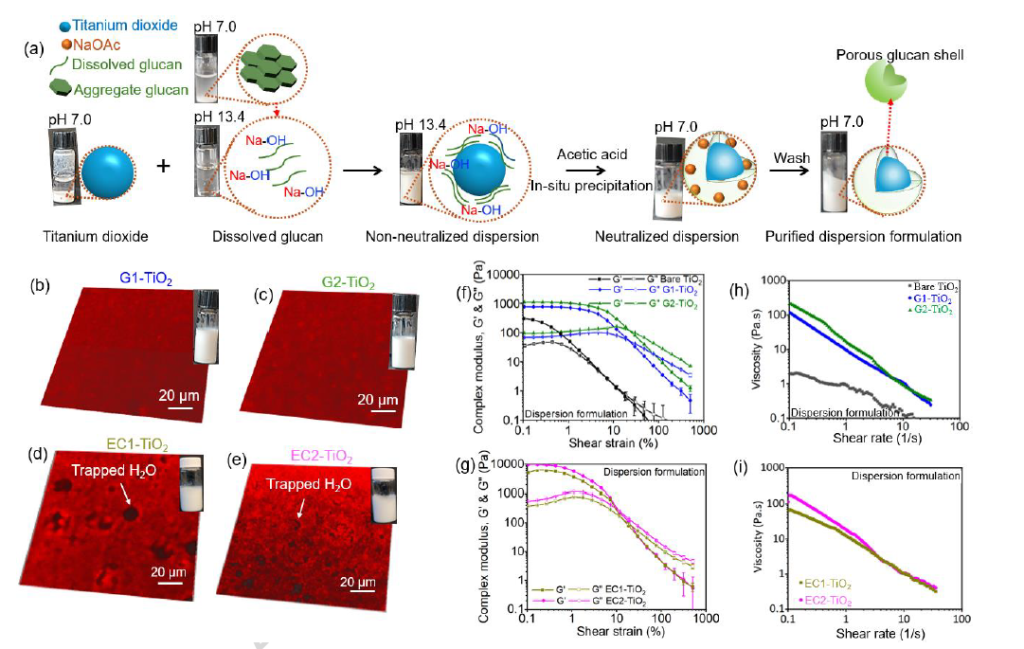
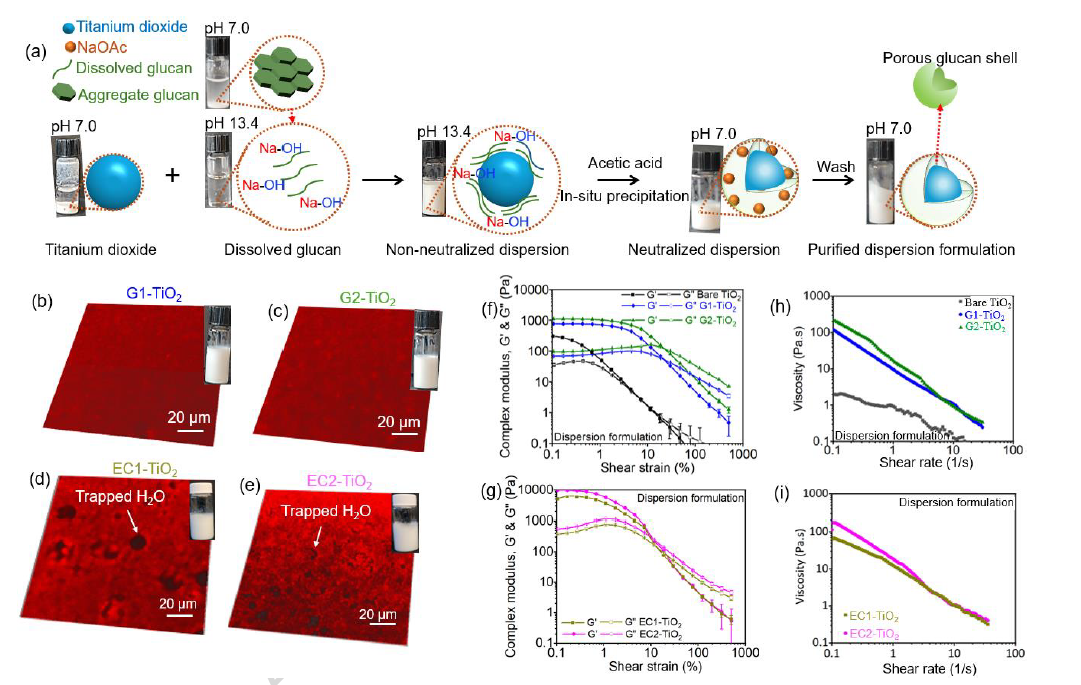
The researchers employed a room-temperature, surfactant-free dissolution-precipitation strategy to create core-shell structures. TiO₂ nanoparticles were first dispersed in isopropyl alcohol to enhance wetting before being mixed with dissolved glucan (in alkaline conditions) or ethylcellulose (in IPA). The polysaccharides were then precipitated onto the TiO₂ surfaces via pH neutralization or solvent exchange, followed by purification to remove byproducts. The resulting core-shell particles were evaluated using electron microscopy, X-ray photoelectron spectroscopy (XPS), and rheological measurements to assess their structural and functional properties.
Key Findings
- Superior UV Protection: The polysaccharide-coated TiO₂ demonstrated approximately 2× higher SPF and UVAPF compared to commercial silica-coated benchmarks.
- Near-Total ROS Suppression: Photocatalytic activity was reduced from ~90% in bare TiO₂ to below 5% in coated systems, with ROS generation levels remaining near the baseline.
- Dual Passivation Mechanism: Passivation occurs through both physical surface shielding and electronic modulation of the TiO₂ interface, evidenced by a +0.2 eV shift in Ti 2p binding energy and increased charge transfer resistance.
- Tunable Optical Response: Performance is thickness-dependent; thinner shells (~2.5–4 nm) maximize UVB protection (SPF), while thicker shells (~6 nm) enhance UVA coverage through increased scattering.
- Enhanced Emulsion Stability: Ethylcellulose coatings provide stable Pickering-type stabilization at the oil-water interface, while glucan-coated particles form a 3D hydrated network in the aqueous phase that resists droplet coalescence.
The novelty of this research lies in its development of a single-step, sustainable surface engineering strategy that utilizes bio-derived polymers to solve the multi-faceted limitations of mineral UV filters. Unlike traditional inorganic coatings, these polysaccharide shells offer a dual-action suppression of photocatalysis through physical and electronic barriers while significantly boosting UV-blocking efficiency. Future implications for this work include the potential for “cleaner” cosmetic formulations that replace complex synthetic stabilizers with multifunctional, bio-based alternatives. However, further in vivo clinical testing and environmental-fate studies are essential to confirm the biological safety and long-term ecological impact of these hybrid nanoparticles before they can be fully integrated into commercial sunscreen products.
Link to the study: https://www.nature.com/articles/s43246-026-01315-6