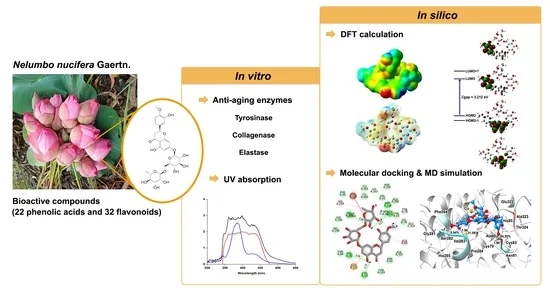
Skin aging is a complex biological process driven by intrinsic factors (such as genetic predisposition, chronological aging, and nutritional deficiencies) and extrinsic factors (such as UV radiation, air pollution, and smoking). These forces collectively enhance the generation of reactive oxygen species (ROS), resulting in oxidative stress that manifests as wrinkles, sagging, and hyperpigmentation. ROS trigger the production of matrix metalloproteinases (MMPs)—especially collagenases, which degrade structural collagen (comprising 70–80% of skin protein), and elastases, which degrade elastin. Additionally, UV radiation activates tyrosinase, the rate-limiting enzyme in melanogenesis, leading to hyperpigmentation disorders like dark spots. To combat these processes, natural polyphenols and flavonoids are highly valued in cosmeceuticals for their ability to scavenge ROS and inhibit these key matrix-degrading enzymes. Nelumbo nucifera Gaertn. (sacred lotus) represents an exceptionally promising natural solution because it is rich in bioactive phenolics and flavonoids (such as quercetin, rutin, catechin, eriocitrin, naringin, and hesperidin) that offer potent antioxidant capacity and synergistic anti-aging benefits.
Methods
The molecular docking of 54 phytochemical compounds from Nelumbo nucifera was performed using AutoDock Vina against tyrosinase, collagenase, and elastase. The chemical and electronic reactivity of the top-ranked compounds was evaluated through B3LYP/6-31G(d,p) density functional theory (DFT) calculations. Further, 100 ns molecular dynamics (MD) simulations were executed using AMBER 2016 to investigate protein-ligand structural stability. Lastly, in vitro spectrophotometric assays and UV absorption studies experimentally validated the enzyme inhibitory and photoprotective potential of the lead compound, hesperidin.
Key Findings
- Strong Binding Affinities: In molecular docking simulations, flavonoid glycosides from N. nucifera showed stronger binding energies than positive controls. Hesperidin, eriocitrin, and catechin 3-O-gallate emerged as top candidates, outperforming kojic acid against tyrosinase, and demonstrating equal or greater binding affinities than EGCG against collagenase and elastase.
- Favorable Reactivity Descriptors (DFT): Quantum chemical analyses revealed that eriocitrin and hesperidin possess narrow frontier molecular orbital energy gaps (Egap of 3.183 eV and 3.212 eV, respectively), indicating high chemical reactivity and enhanced charge-transfer capability during enzyme binding.
- System and Complex Stability (MD): The 100 ns simulations demonstrated that hesperidin-bound complexes achieved structural equilibrium rapidly, displaying lower or comparable RMSD values than reference inhibitors. Hesperidin formed persistent, stable hydrogen-bond networks with key active site residues (e.g., Asn81 in tyrosinase at 84.20% occupancy; Asp175, Glu219, and His218 in collagenase).
- Experimental Enzyme Inhibition: In vitro assays confirmed that hesperidin is a functional inhibitor of all three enzymes, showing IC50 values of 3.43 mM for tyrosinase, 2.26 mM for collagenase, and 0.55 mM for elastase.
- Broad UV Absorption Profile: Preliminary UV-Vis spectrophotometry revealed that hesperidin has strong intrinsic spectral absorbance in the UVB region (280–315 nm) which extends directly into the UVA region (315–400 nm), indicating excellent potential for photoprotective application.
- Enhanced Skin Permeation: Hesperidin possesses a partition coefficient (logP approx 1.78) in the optimal range (1–3) for traversing the stratum corneum, enabling it to accumulate preferentially in the dermis where it protects the extracellular matrix from oxidative stress.
This research provides valuable novelty by offering the first detailed, atomic-level quantum mechanical and computational insights into how Nelumbo nucifera flavonoids interact with key skin-aging enzymes. By coupling in silico predictions with in vitro experimental validation, the study successfully establishes hesperidin as a promising multifunctional cosmetic ingredient. The future implications of these findings are substantial: researchers must now focus on validating hesperidin’s stability and performance in standardized cosmeceutical formulations, alongside conducting clinical photoprotection and dermatological trials to confirm its real-world efficacy and safety on human skin.
Link to the study: https://www.mdpi.com/2079-9284/13/4/210