

Ultraviolet B (UVB) radiation is a primary environmental factor responsible for skin damage, triggering oxidative stress, cellular inflammation, and excessive melanin synthesis in melanocytes. While melanin serves as a natural defense against UV radiation, its overproduction leads to hyperpigmentation disorders such as melasma and solar lentigines, contributing to skin photoaging and uneven tone. Traditional skin-brightening agents often harshly suppress melanogenesis, but innovative treatments that work harmoniously with skin physiology remain limited. To address this, glutathione trisulphide (GSSSG)—a naturally occurring supersulphide molecule with potent antioxidant and anti-inflammatory properties—was evaluated as a potential solution. Previous research indicated that GSSSG suppressed α-melanocyte-stimulating hormone (α-MSH)-induced melanogenesis in 2D cell cultures, making it a promising candidate to test under physiologically relevant UVB-induced stress and in complex 3D human skin models.
Methods
Mouse B16-F0 melanoma cells were pre-treated with GSSSG (20–50 µM) prior to exposure to 20 mJ/cm² UVB irradiation. Intracellular persulphide fluorescence (SSP4), melanin content, and Mitf, tyrosinase, and Cars2 gene/protein expressions were quantified. To assess the role of endogenous supersulphides, siRNA transfection was performed to achieve Cars2 knockdown. Topical 0.1% GSSSG was applied to 3D MelanoDerm human skin models over 15 days to measure L* brightness values. Data were evaluated statistically using one-way ANOVA with Dunnett’s test and Student’s t-test.
Key Findings
- UVB Induces Hyperpigmentation and Depletes Supersulphides: Exposure to UVB significantly increased melanin production and upregulated melanogenic markers (Mitf and tyrosinase), while simultaneously reducing intracellular supersulphide levels and Cars2 protein expression.
- GSSSG Attenuates UVB-Induced Melanogenesis: Pre-treatment with GSSSG (20–50 µM) inhibited melanin synthesis in a dose-dependent manner, downregulated Mitf and tyrosinase expression, and restored intracellular supersulphide content.
- Dual Role of Supersulphides in Melanogenesis: Cars2 knockdown reduced intracellular supersulphides and suppressed basal melanin synthesis, indicating that while supersulphides suppress stress-induced hyperpigmentation, they are also essential for maintaining basal physiological melanogenesis and cellular energy homeostasis.
- Enhanced Skin Brightness in a 3D Skin Model: Topical application of 0.1% GSSSG for 15 days significantly increased L* brightness values in 3D MelanoDerm tissue models without completely shutting down melanin production.
Novelty of the Research: This study provides the first evidence that GSSSG effectively suppresses UVB-induced melanogenesis and enhances skin brightness in a physiologically relevant 3D skin model. Crucially, it reveals a novel, context-dependent regulatory mechanism: supersulphides act as negative regulators during stress-induced hyperpigmentation while supporting baseline melanin synthesis required for normal cellular function.
Future Implications: GSSSG represents a novel class of cosmetic ingredients capable of normalizing skin tone and improving brightness while preserving physiological melanin homeostasis. Future research should focus on human clinical trials, evaluating skin permeability and paracrine keratinocyte-melanocyte signaling, elucidating upstream molecular targets, and conducting long-term dose-response analyses to support commercial formulations.
Link to the study: https://www.mdpi.com/2079-9284/13/5/242
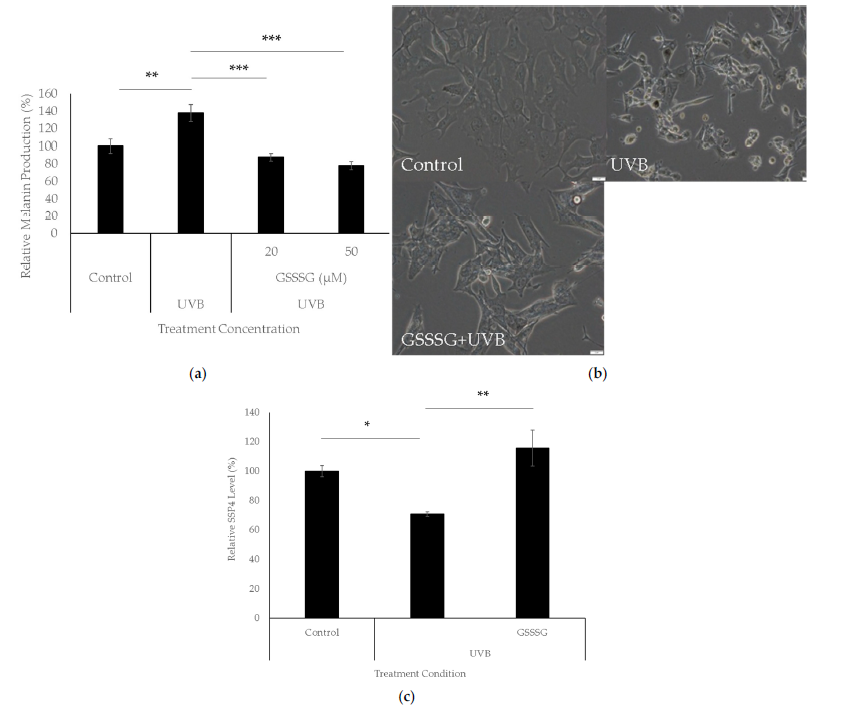
In the figure: Effect of UVB on melanin production and supersulphide levels in B16-F0 cells. Cells were
pre-treated with 20 or 50 μM GSSSG for 0.5 h and exposed to 20 mJ/cm2 UVB. Results are presented
as mean ± SD (n = 3). Statistical significance was evaluated using Dunnett’s multiple comparison
test. Differences were considered significant at p < 0.05 (), p < 0.01 (), and p < 0.001 (). (a) Analysis
of melanin content. (b) Representative image of (a); scale bar = 20 μm. (c) Intracellular supersulphide
levels.